Can a bounce house be set up on concrete? Learn when it is safe, what equipment you need, and how to secure it properly.
A bounce house can turn an ordinary party into something kids talk about for weeks.
But if your yard is mostly a concrete driveway, patio, or parking area, you really want to know can a bounce house be set up on concrete without creating a safety problem?
Well, yes, but only when the inflatable is designed for hard surfaces and is secured correctly.
This matters because concrete does not hold stakes the way grass or soil does. You also have a harder surface underneath the inflatable, which can increase the risk of injury if a child falls or the unit shifts.
If you are looking at bounce house rentals, ask the rental company what surfaces they allow and what anchoring system they use.
A proper setup depends on the inflatable, the location, the weather, and the anchoring method.
Before you start inflating anything, you need to make sure the setup will stay stable from the first jump to the last.
Can a Bounce House Be Set Up on Concrete?
Yes, a bounce house can be set up on concrete, but you should not use regular ground stakes.
Many inflatables can be used on hard surfaces when the manufacturer allows it.
However, the unit must be secured with a suitable anchoring system designed for concrete or another hard surface.
The key issue is not the concrete itself. It is how the bounce house is secured.
A bounce house that is properly anchored can remain stable. One that is simply placed on concrete and inflated is not a safe setup.
Why Concrete Requires a Different Setup
Grass gives you an easy way to anchor an inflatable. Stakes can be driven into the ground and connected to the bounce house’s anchor points.
Concrete is different.
You cannot simply push a stake into a concrete driveway. Instead, you may need an approved system such as:
- Water weights
- Sandbags or approved weight bags
- Ballast systems
- Other manufacturer-approved hard-surface anchors
The correct option depends on the inflatable and its size.
Do not assume that putting a few heavy objects around the unit is enough. The anchoring system needs to keep the inflatable from sliding, tipping, or lifting.
How Do You Secure a Bounce House on Concrete?
If you are setting up on concrete, follow the manufacturer’s instructions first.
The Consumer Product Safety Commission (CPSC) provides safety guidance for inflatable amusement devices, including the need for proper anchoring and supervision.
A typical hard-surface setup may involve these steps:
- Choose a suitable location.
Look for a flat area without cracks, sharp edges, debris, or nearby obstacles. - Check the manufacturer’s requirements.
Confirm that the specific inflatable is approved for use on concrete. - Protect the inflatable.
Use a suitable ground cover or tarp if the manufacturer or rental company requires one. - Position the unit correctly.
Keep it away from walls, vehicles, trees, fences, and other objects. - Use the correct ballast.
Attach the required weights to the manufacturer’s anchor points. - Inflate and inspect it.
Check the seams, blower connection, entrance, exits, and anchor points. - Keep an adult nearby.
Children should be supervised while the inflatable is being used.
Is a Bounce House on Concrete Safe for Kids?
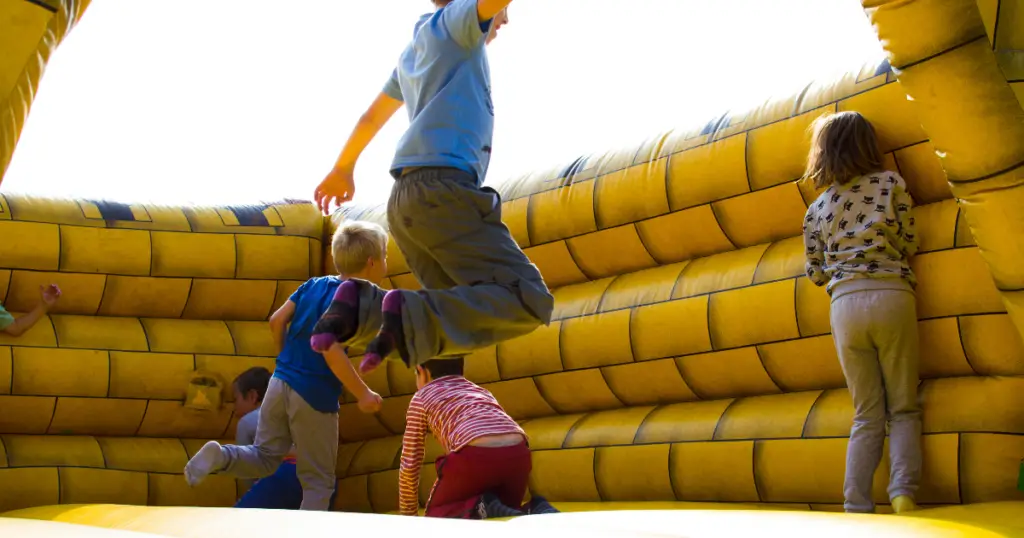
It can be, but the surface underneath matters.
Concrete is much harder than grass. If a child falls outside the inflatable or gets out near the entrance, the hard surface can cause a more serious injury.
That is why you should pay close attention to the entrance and exit area.
A suitable safety mat may be needed to provide a softer landing area, depending on the inflatable and the rental company’s instructions.
You should also keep children from running around the outside of the bounce house.
Safety is not only about the surface. Age, weight limits, weather, supervision, and proper use all matter.
What About Wind?
Wind is one of the biggest concerns when using an inflatable outdoors.
A bounce house is large and lightweight compared with its surface area. Strong wind can move or lift an improperly secured inflatable.
The CPSC warns that inflatables can become dangerous in windy conditions and recommends following the manufacturer’s wind limits and anchoring instructions.
If the weather becomes unsuitable, stop using the bounce house and deflate it according to the manufacturer’s instructions.
Do not rely on heavy weights alone if the manufacturer says the inflatable should not be used in certain wind conditions.
Can You Put a Bounce House on a Concrete Driveway?
A concrete driveway may work if:
- The inflatable is approved for hard surfaces.
- The area is large enough.
- The surface is flat and free from hazards.
- The correct anchoring system is available.
- There is enough clearance around the inflatable.
- Weather conditions are suitable.
- Children can be supervised properly.
You should also consider vehicle traffic. A driveway may look convenient, but you do not want cars moving near children or the inflatable.
For that reason, a closed driveway is generally more practical than a driveway that is still being used for parking.
What About a Water Slide on Concrete?
The situation changes when you are using a wet inflatable.
If you are considering water slide rentals, ask the rental company whether the specific unit can be placed on concrete.
Water can make the surrounding surface slippery. You also need to think about where the water will drain.
You do not want water running toward electrical equipment, garages, doorways, or areas where people could slip.
A water slide may also require additional setup equipment, such as a suitable water source and drainage plan.
When Should You Avoid Concrete?
You should reconsider the setup if:
- The manufacturer does not allow use on concrete.
- You do not have the required anchoring equipment.
- The concrete is badly cracked or uneven.
- There is not enough clearance.
- Strong winds or storms are expected.
- The area has vehicle traffic.
- Water will create a slipping or drainage problem.
- You cannot provide proper adult supervision.
In these situations, moving the inflatable to an approved surface is the safer choice.
Questions to Ask Before Renting
If you are hiring an inflatable, ask the rental company these questions before paying:
- Can this specific bounce house be used on concrete?
- What anchoring system will you use?
- Are weights included?
- How much clearance is required?
- What is the wind limit?
- Do I need a safety mat?
- What happens if the weather becomes unsafe?
A reputable rental company should be able to give you specific answers instead of simply saying, “It will be fine.”
Conclusion
So, can a bounce house be set up on concrete? Yes, but it needs the right conditions and the right anchoring method.
The safest approach is to follow the inflatable manufacturer’s instructions and use an approved hard-surface anchoring system.
Never assume that the weight of the bounce house itself will keep it in place.
Before your party, check the surface, weather, clearance, anchoring, and supervision plan.
Those few checks can make a big difference in keeping the fun focused on the kids rather than dealing with an avoidable accident.